
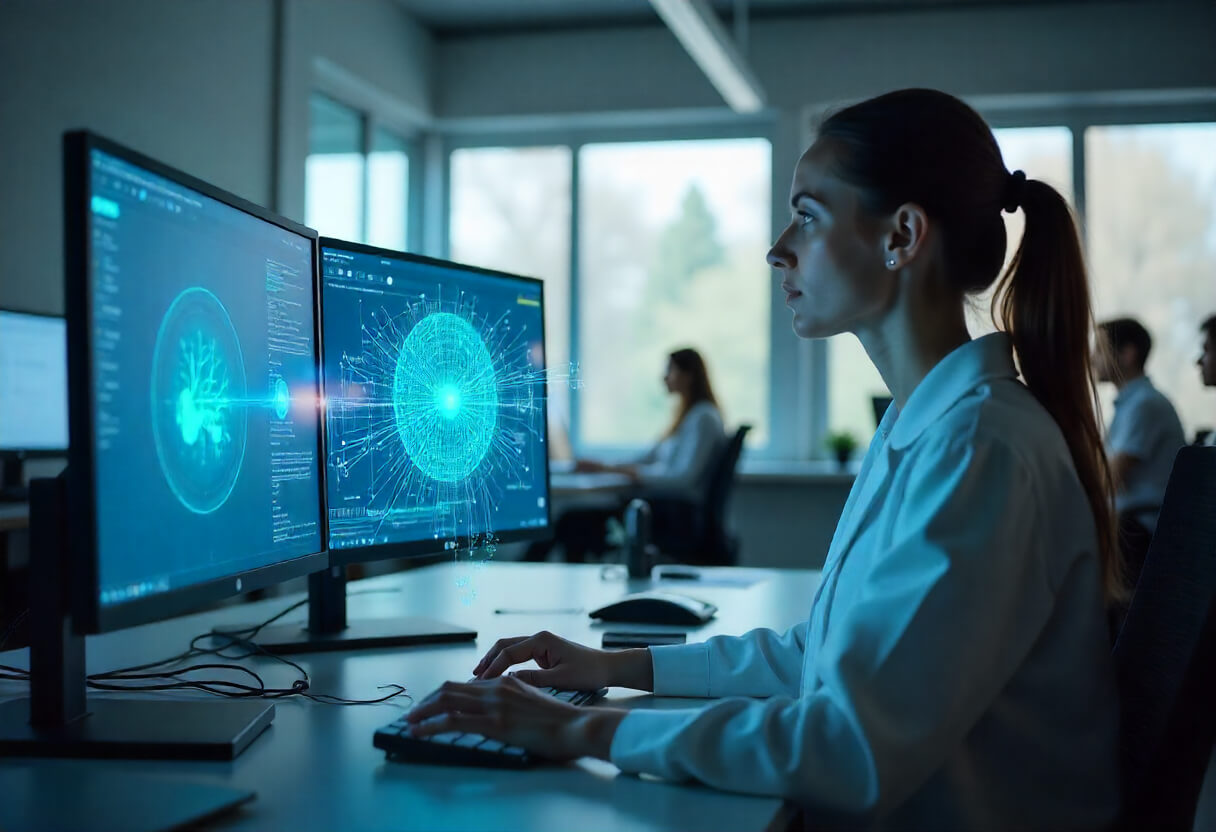
Machine learning and deep learning are at the forefront of artificial intelligence innovation in 2026. These technologies allow computers to recognize patterns, make predictions, and learn from experience, transforming industries, research, and everyday life. Recent breakthroughs have made these systems more powerful, adaptable, and capable of solving increasingly complex problems.
Advances in Machine Learning Algorithms
Machine learning algorithms continue to evolve, with transformers, reinforcement learning, and self-supervised learning leading the way. Transformers are particularly significant in natural language processing and computer vision, enabling AI systems to understand context, relationships, and semantic meaning at unprecedented levels.
Reinforcement learning, which allows AI to learn through trial and error, is now widely applied in autonomous systems, robotics, and strategic simulations. Self-supervised learning reduces reliance on labeled datasets, enabling AI models to learn from vast amounts of raw data efficiently.
Applications Across Industries
Machine learning and deep learning are being applied across a wide range of sectors:
-
Healthcare: AI analyzes medical images, predicts disease progression, and assists in drug discovery, enabling personalized treatments and improving patient outcomes.
-
Finance: Machine learning detects fraudulent transactions, forecasts market trends, and optimizes investment strategies.
-
Retail: AI drives recommendation engines, inventory optimization, and customer segmentation, improving engagement and sales.
-
Transportation: Autonomous vehicles rely on deep learning models to navigate complex environments safely and efficiently.
These applications highlight how machine learning and deep learning are not just theoretical innovations—they are practical tools reshaping business and society.
Challenges in Machine Learning
Despite tremendous progress, challenges remain. Data quality and bias are major concerns; algorithms trained on incomplete or skewed datasets can produce inaccurate or unfair results. Additionally, model interpretability is critical. Many deep learning models operate as “black boxes,” making it difficult for humans to understand how decisions are made.
Computational demands are another challenge. Training state-of-the-art models requires high-performance hardware and large datasets, which can be expensive and resource-intensive. Organizations must carefully balance cost, sustainability, and performance when deploying these systems.
Emerging Trends in 2026
Several key trends are shaping the future of machine learning and deep learning:
-
Transfer Learning: Models trained for one task can be adapted to new tasks with minimal additional data, reducing training time and resources.
-
Federated Learning: AI learns from decentralized data sources while preserving privacy, enabling collaboration across organizations without sharing sensitive data.
-
Multi-Modal Learning: AI systems that combine text, images, audio, and video provide richer, context-aware insights.
-
Explainable AI (XAI): Techniques that make model decisions interpretable and transparent are gaining traction, increasing trust and adoption.
These innovations make AI systems more efficient, versatile, and trustworthy, broadening their impact across industries and research domains.
The Future of Intelligent Systems
The combination of machine learning and deep learning will continue to drive intelligent systems that assist humans in decision-making, problem-solving, and creativity. AI will increasingly act as a partner rather than a replacement, enhancing human capabilities and enabling innovation that was previously impossible.
As organizations adopt these technologies, ethical considerations such as fairness, transparency, and accountability must remain a priority. Proper governance ensures that AI systems serve society responsibly while maximizing their transformative potential.
In conclusion, machine learning and deep learning are redefining what is possible in 2026. From healthcare to finance, transportation to creative industries, these technologies are powering intelligent systems that learn, adapt, and improve continuously. By combining human expertise with advanced AI, we can create solutions that are smarter, more efficient, and more impactful, shaping a future where intelligent systems and humans collaborate seamlessly.